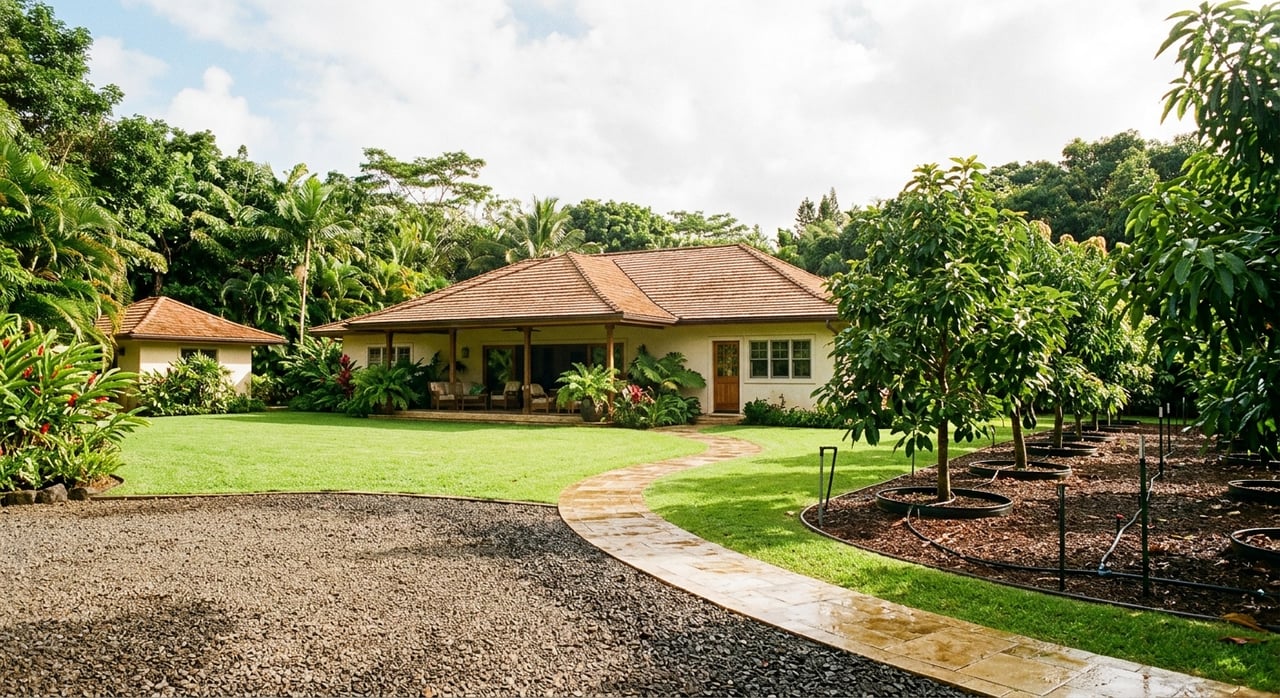
Lawai Acreage Buying Guide for Zoning, CPRs, and Farm Use
May 14, 2026
May 14, 2026
Thinking about buying acreage in Lāwa‘i? A larger parcel can open the door to more privacy, more flexibility, and more long-term value, but it can also come with more rules than many buyers expect. If you are exploring farm potential, multiple dwellings, or a CPR structure, you need clear answers before you write an offer. Here is what to know so you can evaluate acreage in Lāwa‘i with confidence. Let’s dive in.
When you buy acreage on Kauaʻi, parcel size is only part of the story. The County of Kauaʻi Planning Department administers zoning permits, use permits, variance permits, special permits, Special Management Area permits, and shoreline setback determinations. That means your first step is to confirm the parcel’s zoning and any applicable overlay maps, not assume that more land automatically means more building rights.
For many Lāwa‘i acreage buyers, Agricultural zoning is where the key questions begin. County rules in the Agriculture District are designed to preserve agricultural stability and limit premature parceling. In practice, that means subdivision and build-out options may be more limited than buyers expect at first glance.
One of the most common questions is simple: how many homes can you have on the property? In Kauaʻi’s Agriculture District, the county allows one dwelling unit on a parcel that is at least one acre, plus one additional dwelling unit for each additional three acres, with a maximum of five dwelling units on one parcel.
The county’s agriculture parcel build-out guide makes those thresholds easier to read:
This is one of the most important numbers to verify during due diligence. If your goal is a main residence plus additional dwellings, the parcel’s exact acreage can materially change what is possible.
Guest houses often cause confusion on acreage purchases. Kauaʻi’s build-out guide shows that guest houses may be allowed in Agriculture zoning, but they are capped at 800 square feet and are not CPR-capable.
That distinction matters. A guest house is not the same as an additional farm dwelling unit, and it should not be viewed as a substitute for extra density. If you are comparing two acreage properties, this difference can affect both your design plans and your long-term ownership strategy.
A CPR can be useful on acreage, but it is not a workaround for land-use rules. Under Hawaiʻi law, CPR projects must comply with county zoning and all county permitting requirements. Counties may also adopt supplemental CPR rules, which means the county still controls what can actually be built and how a property may be used.
The Hawaiʻi Department of Commerce and Consumer Affairs explains the distinction clearly. A subdivision creates separate parcels, while a CPR creates shared undivided ownership with exclusive-use rights. Just as important, CPR law does not decide how many dwellings or structures a parcel may have. County planning rules do.
If you are considering a CPR on Lāwa‘i acreage, focus on these points early:
For agricultural CPR projects, the declaration must state that the project complies with zoning, building, and permitting rules. In an agricultural district, it must also state that there are no private restrictions limiting or prohibiting agricultural uses or activities.
DCCA also notes that projects with code violations or unpermitted additions are generally not registrable until those issues are corrected. For buyers, that makes permit history and improvement records especially important.
Kauaʻi’s current rules are especially important if a property includes a guest house. A 2024 county ordinance says a guest house may not be separated from its primary dwelling by a CPR. DCCA also says guest houses and ARUs may remain in the same condominium project only if they stay tied to the primary dwelling unit.
In plain terms, if a seller or marketing package suggests that a guest house can function like a separately transferable unit, that claim deserves close review. On Kauaʻi acreage, not every structure can be isolated within a CPR the way buyers sometimes assume.
Many acreage buyers in Lāwa‘i are drawn to orchard plans, small-scale farming, horses, or a working rural lifestyle. That can be a great fit, but the county uses a specific definition for agricultural use in its Agricultural Dedication Program. The land must be actively used to produce agricultural products for monetary profit.
The county also states that agricultural use does not include selling, refining, or distributing products that were not grown or raised on the parcel. So if your vision involves a farm stand, value-added products, or resale activity, it is important to confirm whether the parcel’s actual on-site production supports that use.
Equestrian use is another area where details matter. County dedication rules distinguish between hobby horse keeping and commercial operations.
Recreational or hobby horse keeping is not agricultural use. Commercial breeding, boarding, trail riding, equestrian training, and ranching may qualify when the activity is continuous, commercial, and supported by on-site facilities or other indicators of a working farm or ranch operation.
If horses are part of your plan, ask targeted questions about:
Some buyers assume employee housing is a simple accessory use on agricultural land. On Kauaʻi, that is not the case. The county recognizes farm worker housing as a separate permitted-use path that requires a use permit, proof of commercial farm activity, agricultural dedication, and a farm plan.
That makes farm worker housing its own due diligence category. If your plans involve on-site staff or agricultural employees, this should be reviewed early with the county rather than treated as a routine addition.
Water is one of the biggest practical issues on acreage. The Kauaʻi Department of Water notes that the island’s isolated location limits access to freshwater resources despite its wet climate. The south shore Lāwa‘i-ʻŌmaʻo area is part of the Kalaheo-Koloa system and is served by Lāwa‘i Wells No. 1 and 2 and Pīwai Wells No. 2 and 3.
If you are evaluating agricultural operations, it is also important to understand that agricultural water service is not the same as ordinary residential service. The department requires an annual application and proof of commercial agriculture. Agricultural service is also interruptible if shortages occur or if domestic users are curtailed.
For a buyer, that means water planning should match the intended use of the property. A residence, orchard, equestrian operation, and farm-related improvements may each raise different questions about service needs and reliability.
Even when zoning looks favorable, overlays and site conditions can still limit what you can build and where. Kauaʻi’s code includes flood, sea-level-rise, slope, soils, and tsunami constraint districts. There is also a separate shoreline setback article with its own setback determination and variance procedures.
These constraints can affect building envelopes, placement of structures, and project timing. On some agricultural parcels, the Planning Commission may also require public access ways at least 10 feet wide to publicly owned land or waters. Because of that, title review, access review, and easement review are all important parts of acreage due diligence.
The Planning Department advises buyers to consult staff to confirm the correct permit path. Depending on the parcel and the improvements you want, zoning permits, use permits, variance permits, special permits, and SMA review may all come into play.
Guest houses come with added pre-permit requirements. County ordinance requires written confirmation of wastewater or sewer capability, water availability, and Fire Department approval before building permit review.
For buyers, that means a guest house concept should be tested against actual utility and approval conditions, not just lot size or a rough sketch of the site.
Before you move forward on an acreage purchase, it helps to organize the decision around a few key categories:
On Kauaʻi, acreage can be exceptionally rewarding when the parcel matches your goals. The key is to understand the rules early so you can buy the right property, not just a beautiful one.
If you are considering land or acreage on the South Shore, working with a local advisor who understands zoning, parcel strategy, and the realities of Kauaʻi due diligence can save you time and help you avoid expensive surprises. For tailored guidance on Lāwa‘i and nearby South Shore opportunities, connect with Brenda Crawford.
Stay up to date on the latest real estate trends.
Etiam non quam lacus suspendisse faucibus interdum. Orci ac auctor augue mauris augue neque. Bibendum at varius vel pharetra. Viverra orci sagittis eu volutpat.